News about Tylenol!

On September 22, 2025 the U.S. Food and Drug Administration changed the label for Tylenol (acetaminophen) to suggest that use of it by pregnant women may be associated with an increased risk of autism and attention deficit disorder (ADHD) in children. Since this is one of the most often used medications in pregnancy, how should you react to this change in policy? Let’s look at the evidence.

The question about safety of acetaminophen in pregnancy has been studied for over a decade. In 2015 the FDA conducted a review of the subject and concluded that there was no causal relationship between acetaminophen and ADHD. Further studies by the Society of Maternal-Fetal Medicine reached the same conclusion. In 2021 the American College of Obstetricians and Gynecologists issued a statement that the standard of care for using acetaminophen in pregnancy was unchanged. An August 2025 study review included 10 new studies and concluded no significant association between prenatal acetaminophen and neurodevelopmental outcomes.

U.S. Health and Human Services Secretary Robert F. Kennedy Jr. has made finding possible causes of autism a priority for research, launching the $50 million Autism Data Science initiative. Yale School of Public Health Professor Dr Zeyan Liew has spent years investigating causes of neurodevelopmental disorders and he says that there is no proven causal relationship between acetaminophen use and autism. Other factors, such as underlying illness or genetic predisposition could play role in causing autism.

Maternal conditions for which acetaminophen is recommended, such as fever, migraines, headaches and pain, can lead to significant maternal and fetal morbidity and mortality if not treated. For example, fever during pregnancy can lead to an increased risk of birth defects. In considering whether to take it, we must think about whether there is a greater benefit or a greater risk.

Our parent organization, ACOG, reaffirms that acetaminophen remains the pain medication and anti-fever medication of choice in pregnancy. Unfortunately, there is no equivalent alternative medication as other over the counter pain medications are recommended to be avoided due to their risks. Using acetaminophen at the lowest amount that is effective for the shortest duration of time is the safest approach. Furthermore, the current evidence does not support a link between developmental disorders and use in pregnancy.

RSV Vaccine in Pregnancy 32-36 Weeks

We recommend the Pfizer RSV vaccine if you are 32 to 36 weeks pregnant from September to January. The vaccine creates antibodies that pass to your fetus. This means the baby will have some antibodies to protect them from RSV for the first 6 months after birth. 

RSV, or respiratory syncytial virus, is a virus that spreads in the fall and winter. RSV can be dangerous for babies and young children. It is the leading cause of hospitalization among infants in the United States.

There are multiple RSV vaccines approved by the U.S. Food and Drug Administration (FDA). The only RSV vaccine approved by the FDA for use in pregnancy is the one made by Pfizer. It is called Abrysvo

You can get the Pfizer RSV vaccine at the same time as other vaccines recommended during pregnancy. Common side effects of the RSV vaccine include arm pain, headache, muscle pain, and nausea, similar to other vaccine side effects. Side effects are normal and not a cause for concern.

The RSV vaccine is one of two new options for protecting babies during RSV season. There is also an option to give babies an injection called Nirsevimab. Nirsevimab contains lab-made antibodies that protect against RSV. It is not a vaccine. Please talk to your pediatrician to see if this is an option at their office for your newborn. 

You can get the Pfizer RSV vaccine at the same time as other vaccines recommended during pregnancy. 

In most cases, you should choose between the RSV vaccine during pregnancy and Nirsevimab after birth. The goal is to protect your baby from RSV, either with antibodies made during pregnancy or with antibodies given directly to your baby after birth. 

We can help you decide between these two options. You may want to consider the following:

The RSV vaccine gives your baby protection right after birth. If you get the RSV vaccine, there is one less injection for your baby to get after birth. Nirsevimab may provide your baby with longer-lasting protection but confirm with your pediatrician, this will be an option for your baby at their office. It may be hard to get Nirsevimab this fall and winter.

• • • 

List of pharmacies our pregnant patients have received their vaccines without issue:

  1. Walmart in Germantown
  2. Costco in Gaithersburg 

by Dr. Supriya Mishra

Sterilization by Laparoscopy BISALP

Let’s talk about permanent sterilization or getting a “BISALP”

There has been a lot of discussion lately on social media platforms regarding this. On Reddit/Facebook/Instagram there are many threads on “getting your tubes tied.” I would like to share my support and present reliable information regarding this on our website as well for you. 

I have placed my name on a list of physicians who are willing to perform sterilization procedures on women despite the number of babies they’ve had or their marital status. As always done in my practice, I will counsel you on all the options of contraception including the risks/benefits of female sterilization. We can discuss the option of vasectomy for your partner and where I would recommend to go for this outpatient procedure. We can discuss the option of placing a LARC contraceptive to help with heavy periods while also completing permanent sterilization if desired. 

If after our discussion about even the risk of regret and the usual risks of laparoscopic surgery etc, you would still like to have surgery, then I am happy to walk you through that process. I operate at Adventist Shady Grove Hospital. 

Please call and speak to my office staff if you would like to come in for a consult. You may bring a friend/family member to the consult for support if you choose. 

Here is a thorough FAQ list about permanent sterilization for men and women:

-Dr. Mishra

We Recommend You Get Vaccinated!

We recently have received communications from the Maryland Department of Health and from the American College of Obstetricians and Gynecologists regarding whether pregnant women should become vaccinated:

This image has an empty alt attribute; its file name is Vaccinate-2-1.jpg
This image has an empty alt attribute; its file name is Screen-Shot-2021-02-14-at-12.00.22-PM-2-1024x957.png

ACOG stated that “pregnant patients with COVID-19 are at increased risk of more severe illness compared with non pregnant peers.”
“These data indicate an increased risk of ICU admission, need for mechanical ventilation and ventilatory support (ECMO), and death reported in pregnant women with symptomatic COVID-19 infection, when compared with symptomatic non-pregnant women.” “ACOG recommends that COVID-19 vaccines should not be withheld from pregnant individuals who meet criteria for vaccination.”

Considering the relative safety of the vaccine compared with the much greater short-term and unknown long term risks of the virus, we recommend you do what we did, Get Vaccinated!

We are working to be able to provide the vaccine in our office. Until that is available, we recommend you get the vaccine as it becomes available wherever you can.

Fetal Movement Counting

Myths about Fetal Movement Counting

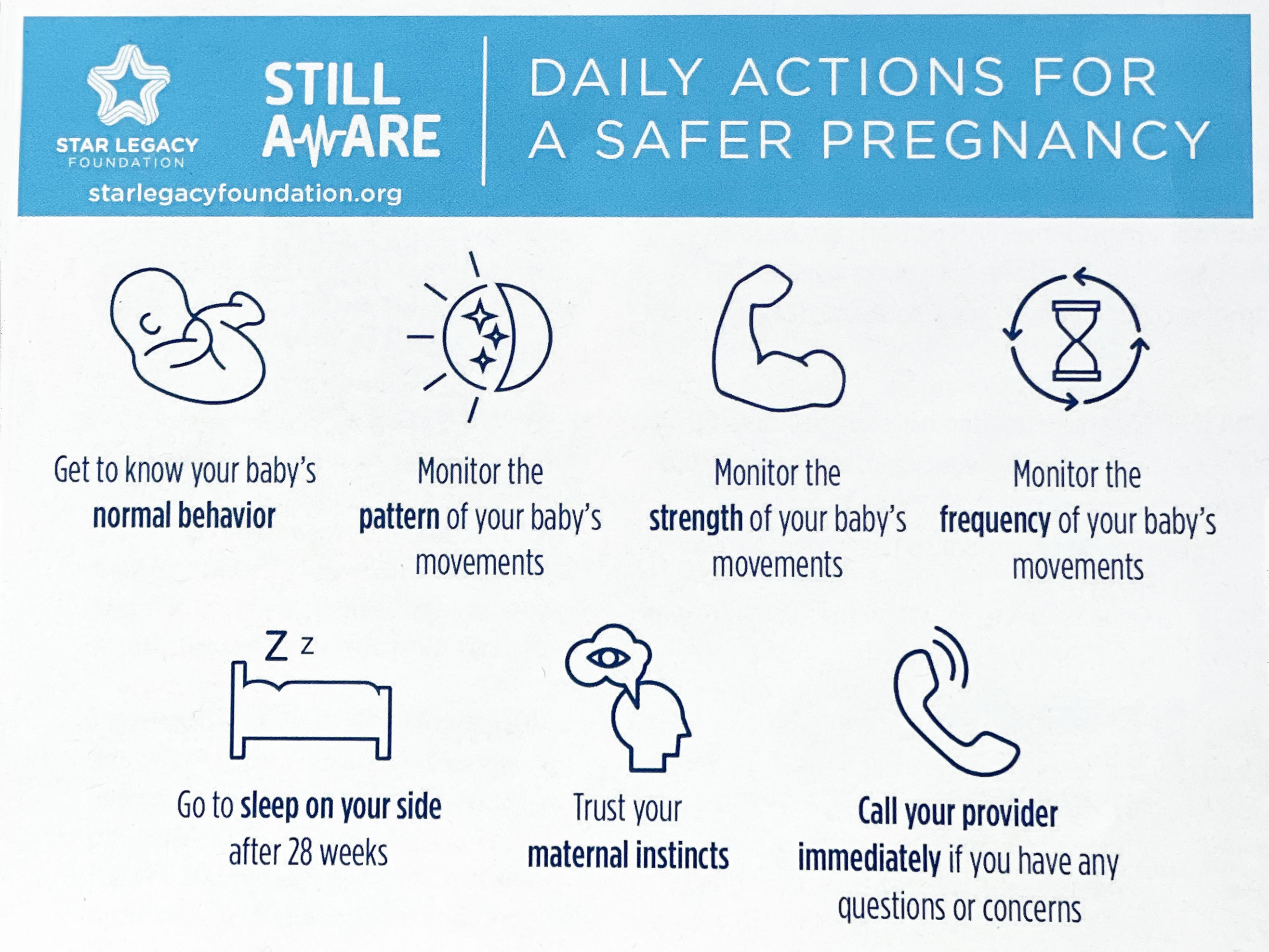
Counting your baby’s movements in pregnancy is important and worth doing. But education about how to do it right is not widely available. In this post we will discuss myths about fetal movement counting.

Myth 1: Kick counts reassure. The standard advice given to pregnant women is to check in on your baby and call if there are less than 10 kicks per hour.  This is not bad advice but research shows that while most moms will pass that test there is no data on which percentage can perceive decrease movement and still pass. For example, if you normally feel 50 movements in an hour, sensing only 10 represents a significant drop. So if you are worried about a concerning change in fetal movement, please give us a call.

Myth 2: Fetuses slow down at the end of pregnancy. A 2019 study looking at fetal movement showed that fetal movement does not decrease in frequency or strength at the end of pregnancy.  It found that only 6% of patients noticed decreased fetal strength and 14% noticed decreased frequency of movements at term. Furthermore, 59% noticed an increase in strength and 39% noticed an increase in frequency of movements. 

Myth 3: Patients should try juice, ice water or food before evaluation. Common advice when patients notice a decrease in movement is to recommend having a sweet cold drink before calling to report a potential problem. Studies about this have not shown improved reactivity when testing is done. When a patient calls with decreased fetal movement, advice should be to come and be evaluated, not have cold liquids or a sugary meal, as it is not supported by research.

Myth 4: An increase in fetal movement is not of concern. An increase of fetal movement can sometimes occur before a stillbirth. A single episode of excessively vigorous activity which is often described as frantic or crazy is associated with an odds ratio for stillbirth of 4.3. In a study, 30% of cases reported it, compared with only 7% of controls (BMC Pregnancy Childb 2012 10.1186/1471). In our practice,  we manage mothers who call with this concern the same way as a report of decreased fetal activity, and bring in the mom for immediate evaluation.

Myth 5: Patients all know that a concerning change in fetal activity is a risk factor for stillbirth. Decreased fetal movement has been associated with an increased risk of stillbirth. However patients often do not know about this. OB physicians are sometimes reluctant to discuss this issue due to fear of anxiety it can provoke. Most patients are very appreciative of receiving this information and feel reassured that help is available if needed.

Conclusion: When I think about the patients I cared for who have had a stillborn baby, I recall that they often come in for evaluation of a different complaint, such as a labor check or a routine prenatal visit. When asked about it, they will sometimes say they last felt fetal movement several days before. This does not need to happen. Protocols have shown that when patients have received education about fetal activity, they will call sooner to report a potential problem. Not all stillbirths can be prevented, but being more aware of changes in your baby’s activity can be successful at minimizing your risk.

Covid-19 OBGYN Update

Stop the Spread of Germs (COVID-19)

In Montgomery County, Maryland we are heading into an expected surge in infections with the Covid-19 virus. We are trying to make everyone safer by following these precautions:

  1. If you are having symptoms such as fever, cough, shortness of breath:
    1. Call your primary care physician
    2. Stay home except for medical care
    3. Limit contact with others in your home
    4. Practice good hygiene with frequent had washing, cleaning common surfaces, and covering your cough or sneeze with your elbow, not your hands
    5. Manage symptoms at home with over the counter medications for fever and cough. Currently Nsaids such as ibuprofen are not recommended.
    6. Get plenty of rest
    7. Stay well hydrated
  2. If you are sick, keep in touch with your doctor. Most cases of Covid-19 are mild and do not require a trip to the ER or hospital. If your symptoms worsen to high fever an difficulty breathing, call your doctor or health facility before you go there. This can help them to prepare for your visit.
  3. If you are in Labor, Shady Grove Adventist Hospital remains open, but there are changes in procedures:
    1. In order to minimize exposure, only ONE visitor will be allowed in Labor and Delivery.
    2. Only the ER entrance should be used from 8pm to 5am.
    3. Visitors will be screened for flu like symptoms and will not be permitted to enter if positive.
    4. Visitors who have traveled internationally will not be permitted to enter.
    5. No visitors under age 18 unless they are a parent of a child in the hospital.
    6. Hospital Tours and Childbirth classes are suspended. We recommend as a substitute online classes such as mybirthly.com
  4. Our office remains open, but we have suspended routine gyn visits. We continue to encourage prenatal visits as long as you have no symptoms of the virus. If you have questions about whether or not to come, please call us first.
  5. Unfortunately, we also must limit visitors to our office. We request that you do not bring visitors to our office including husbands, partners and children until this crisis has passed unless they need to be present for translation.

COVID-19, an OBGYN Perspective

COVID-19 map.png

COVID-19 was first recognized in Wuhan China. It started in December 2019 with one case and by the end of two months it had grown to over 70,000 cases. As of early March it has been diagnosed in over 100,000 people and has killed 3300. Currently it is most prevalent in China, South Korea, Iran, Italy, France, Germany and the US, which is ranked 7th in the amount of cases.


Patients who get sick with COVID-19 have cough and fever, sometimes with muscle aches or chills. In the more severe cases patients can have viral pneumonia. In the worse cases patients develop a syndrome called ARDS which is a pulmonary syndrome and is similar to that seen with a different virus called SARS which was prevalent in 2002.


Some patients’ symptoms can also be GI symptoms such as nausea, vomiting or diarrhea. In China approximately 80% of those infected developed mild symptoms and did not require any medical intervention. About 15% required hospitalization and 5% required critical care.


The overall mortality rate of the disease is difficult to calculate because of the different ways it is being diagnosed around the world. We find severe cases first so there is probably an over-representation of those cases and the mortality rate is probably lower than current estimates. The more that we do diagnosis, the more we diagnose mild cases. In South Korea with the greater availability of testing, the mortality rate was found to be 0.6%, which is probably more accurate than the numbers from China. The risks are substantially higher in people who are older than 70. At present, it does not appear that pregnancy increases your risk.


The virus has a 1 to 14 day incubation period, with the average incubation of about 5 days. The virus is spread by respiratory droplet with close contact, usually within 6 feet. In China as many as 20% of cases have no symptoms which makes it more challenging to identify it and contain it.

In China they took major interventions to contain the virus such as closing cities, canceling mass gatherings, closing of travel routes, closing of businesses, closing schools and confining people to homes.


The US has moved to increase capacity for testing to make tests available for any patient with symptoms who needs it. The government is proceeding with making drive through testing centers available in all communities. Local government and hospitals are gearing up to make testing and treatment available in our community.


Our practice plans to stay open and continue to see our OBGYN patients. To help us help you, please do not come to our office if you have symptoms of this infection, such as fever, chills, cough, muscle aches, or recent exposure to someone who did. Feel free to reschedule your non-emergent gynecology visit.


If you want to be tested for the virus, Montgomery County has a hotline to find out where to go: 240-777-1755. You can also find out up to date information about the virus at the COVID-19 Johns Hopkins site.  If you have further questions about whether or not you should come in for your visit, please call our office before coming in.


Thanks!


Closing the Orgasm Gap

This image has an empty alt attribute; its file name is Screen-Shot-2019-01-06-at-12.28.58-PM-1024x571.png

Statistically, women report fewer orgasms than men. A study in orgasm frequency of US adults showed heterosexual men usually orgasmed during intimacy (95%) followed by gay men (89%), bisexual men (88%), lesbian women (86%), bisexual women (66%) and heterosexual women (65%). Women who orgasmed more frequently were more likely to receive more oral sex, have longer duration of sex, be more satisfied with their relationship, ask for what they want in bed, act out fantasies and express love during sex. Women were more likely to orgasm if their last sexual encounter included deep kissing, manual genital stimulation and oral sex in addition to vaginal intercourse.

Why the Orgasm Gap Exists

There are theories as to why women don’t orgasm as much as they’d like to. There is too much emphasis on penetrative sex. Our Western culture is goal oriented. For men the goal is to orgasm, and then the fun stops. Biologically, it’s more difficult for women to achieve orgasm from penetrative sex alone. According to sex experts 80% of women do not orgasm through intercourse alone. Most need direct clitoral stimulation to experience orgasm.

Female Orgasm During Intercourse

Fortunately there are ways to ensure women experience mind-blowing orgasms during sex. Penis in vagina intercourse is just one type of sex. Using your hands and mouth to arouse one another should be a central part of your sex life. Start with lots of full body touch. We recommend female orgasm or high arousal before penetration. Using your fingers in the vagina before inserting a penis can help warm her up. Emphasize clitoral stimulation before and during intercourse. The clitoris is the anatomical match to the penis, so just imagine men trying to reach orgasm without touching their penis and you’ll get a sense of how essential clitoral stimulation is to female orgasm. It can be easiest for her to keep touching her clitoris once intercourse has started.

The first moment of penetration can be exquisite and set the tone for the entire time. Make sure to not penetrate until she is ready. Try holding still and letting her slide onto the penis at her own pace, or going in one inch at a time.  Wetness is not a good indicator of arousal. Women can be aroused but not wet, or wet but not aroused. Whenever it is needed, use good quality lube.  Explore different depths, rhythms and speeds. Ask her what works well for her. Experiment with sensible sex positions. Focus on comfort and the ability to thrust and move easily. Take turns being the more active one. Try making sex last longer with foreplay, more attention to her pleasure, and gaining control over ejaculation. Have fun with extras such as holding still while she squeezes and releases pelvic muscles, make and hold eye contact, using full body touch during intercourse to maximize skin to skin contact. Adjust your erotic attitude from sexual scarcity to sexual abundance.

Four Ways to Close the Orgasm Gap

Explore the many, different kinds of female orgasm.

This image has an empty alt attribute; its file name is screen-shot-2018-11-24-at-9-46-48-pm1.png
This image has an empty alt attribute; its file name is screen-shot-2018-11-24-at-9-41-03-pm1.png

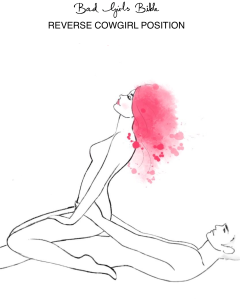
The Clitoral orgasm is from the clitoris, a small organ filled with nerve fibers that is derived from the same tissue in utero as the penis. It becomes erect and engorged with blood during sexual arousal. There are 2 sex positions that allow for more direct stimulation of it, the CAT (coital alignment technique) and the Reverse Cowgirl.

The Reverse Cowgirl sex position is one of the more well-known positions out there. Your man first needs to start by lying down on his back. You then get onto your knees, with one on either side of him, and lower yourself down on him while facing toward his feet. You lean against his upper thighs and grind against him to stimulate your clitoris. The CAT position is great if you like clitoral stimulation. You lie on your back with your legs open while your man is on top of you. But instead of thrusting in and out, you man moves forward so that the angle of the penis is more pointing downward so that his pubic bone will come into contact with your clitoris. It can also be performed with a strap-on.

The G-spot orgasm is from a sensitive area in the front wall of the vagina. When stimulated correctly, many women report intense orgasms that are different from clitoral orgasms. To stimulate the G-Spot curl two fingers into the vagina and press them into the upper wall in a come hither motion. Or slide 3 fingers into the vagina and sweep them back and forth like windshield wipers against the upper wall. The more you take the time to get to know your G-spot and what type of stimulation feels good, the more pleasure you’ll be able to derive from this erogenous zone.

The Blended orgasm is a combination of two or more different types, such as from stimulation of clitoris and nipple.

Anal orgasm involves intense pleasure from stimulation of nerves in the vagina and rectum. So for vagina owners, it may be possible for sexual arousal to occur from rectal stimulation. This definitely needs extra lubrication!

The Nipple orgasm can occur from breast stimulation as the nipple is an erogenous zone for many people and can lead to incredible orgasms. For men and women, nipple play is rewarding foreplay. A study showed that nipple stimulation enhanced sexual arousal in 82% of women and 52% of men. Nipples attract women, just like they do men. A University of Nebraska study found that women and men follow similar eye patterns when looking at women. They quickly look at breasts before moving on to other areas of the body. Piercing? In a study from 2008 94% of men and 87% of women polled about their nipple piercings said they’d do it again. They liked the look of it.

The Fantasy orgasm is possible if your brain is powerful enough to take your daydreams into orgasm territory with nothing more than naughty thoughts!

If you’re a fitness junkie, a Coregasm might be for you. Also known as exercise-induced orgasms, they occur during workouts, and may be due to vibrations from the abdominal and pelvic muscles.

Masturbate More

This image has an empty alt attribute; its file name is screen-shot-2018-11-24-at-9-26-39-pm.png
This image has an empty alt attribute; its file name is screen-shot-2018-11-24-at-9-25-52-pm.png

It doesn’t take two to have an exciting empowering sex life. Masturbation is good for your health and for improving your sexual encounters with your partner. There are numerous health benefits such as a boost of endorphins, reduced anxiety, a better sex life and increased blood flow to the vagina, which can reduce dryness and be especially helpful as you become older. Friction can cause discomfort, so using a lubricant (see pictures of two good brands) can help. For clitoral, try lying on your back.  With a pillow under your head, spread your legs and start to rub your clitoris with whatever feels good. For vaginal, try squatting. Squatting makes it easier to find your G-spot, whjch is about 2-3 inches inside your vaginal canal. Slide your fingers or toy inside your vagina, moving deeper as you go. For anal, try face-down doggy style. The position gives you room to insert your fingers or toy in your behind with one hand while rubbing yourself with the other. For the combo, try the pretend lover. Think of the pretend lover as the cowgirl for one. Put your favorite dildo or vibrator on your bed, and lower yourself down until you find a sensation you like- either penetration, clitoral or both. Ride your toy as fast or slow as you want. At the same time rub your clitoris or play with your nipples. If you want to get your other senses involved, erotic stories can let you discover your sensual and sexual side. Check out literotica.com for some femme-friendly stories. If you’re more visual, watching porn can increase your libido and relieve stress in a safe way. If you like listening, audiobooks.com has steamy audio books. Masturbation is a fun, sexy and safe way to explore your desires and learn what turns you on.

Sex Toys Can Help Erase the Orgasm Gap

This image has an empty alt attribute; its file name is screen-shot-2018-11-24-at-9-24-56-pm.png

Some people think sex toys are for solo sex only, but using toys in the bedroom can be a shared experience, and can help take some pressure off when it comes to helping your partner orgasm.  Toys come in all shapes and sizes, and many of them emit a range of vibrations that you can adjust to your need and desire. Three companies who sell sex toys are We-VibeLelo and Tantus.

Communicate with Your Partner

This image has an empty alt attribute; its file name is screen-shot-2018-11-24-at-9-21-22-pm.png

To better communicate,  demand you get what you need. Women are less likely than men to verbalize their sexual desires or speak up when they are not satisfied during sex. As for men, they assume that women all want the same thing in bed. All women are different with different wiring, different anatomy and different responses.  If you feel awkward stating your desires during sex, you can start beforehand. Not sure what to say? Here’s a list:

The orgasm gap does not have to exist. Women deserve just as much pleasure as men. With a little attention to detail and more focus on female pleasure, you can narrow the gap for good, and that’s something worth getting excited about!

Are Hormones for Menopause Safe?

I recently attended the American Congress of Obstetricians and Gynecologists Annual Clinical Meeting and heard an excellent talk from one of George Washington University’s Professors, James Simon MD. The talk was inspirational! He spoke about a very important topic, “The Status of Hormone Replacement Therapy.”

By way of background, in the past many women were treated for symptoms of menopause with hormones, but in 2002 a report came out, called the “Women’s Health Initiative,” which changed everything by painting a very negative picture about the harm that hormones could cause. As a result, many women, all over the world, were scared into stopping hormones, and some of that fear persists to this day, despite much evidence to the contrary. Years later we have gradually discovered that the study was deeply flawed.

Dr Simon described this as an example of a  “Zombie Idea,” an idea that should have been killed by evidence, but refuses to die! This actually is similar to the current situation involving fear of vaccines, which was originally based on a fraudulent and discredited study, but still lingers on despite overwhelming evidence of vaccine safety.

Similarly, the WHI Study from 2002 was also flawed and following its recommendations has caused harm.

We now know about the “timing hypothesis” that the safety of starting hormone replacement therapy depends on when it is started in relation to menopause. Studies show a much decreased risk of complications such as stroke or heart attack if the woman starts treatment within 10 years of menopause.

Transdermal patches as a way of receiving hormones appear to decrease the risk even further, according to an extensive French study.

Re-analysis of the old WHI data shows no effect of hormones on causing breast cancer.

A Finnish nationwide study showed a decreased chance of death from breast cancer if hormone therapy with either estrogen or estrogen with progesterone was used.

To make it even more definite, a review of 17 studies looking at the risk of recurrence of breast cancer in women who had previous breast cancer, showed that 16 of the 17 studies had either no change or a reduction in recurrence of cancer if they were on hormone therapy.

Another review showed women lived longer if they received hormones starting at age 50-59. This looked at death from all causes, death from cancer, and death from stroke or heart attack.

The risk of Alzheimer’s disease or dementia was decreased by use of hormones.

How do hormones compare with other medications? Surprisingly, recent  studies found an increased risk of breast cancer from taking statins, which are often prescribed for high cholesterol levels. Medicines prescribed for improvement of bone density such as Pioglitazone showed an increased risk of breast cancer of 88 per 10,000.

Surprisingly, analysis showed one of the most dangerous medications causing breast cancer is Vitamin D, which caused 70 per 10,000 additional cases of breast cancer.

What was the aftermath of stopping hormonal therapy based on the WHI report when it came out in 2002? A study in 2009 showed a significantly increased number of bone fractures. Another study in 2011 shows more hip fractures in women who stopped hormonal therapy compared with those who continued it.

Was there an increased risk of death from stopping estrogen therapy? A study in 2013 showed over a 10 year span, starting in 2002, a minimum of 18,000 and as many as 91,000 US women died prematurely because of the avoidance of estrogen therapy.

The conclusions are that hormone therapy risks are rare, and even more rare when started in women who are less than 60 years old and/or within 10 years of beginning menopause. Starting it at a younger age does decrease the risk and increase the benefit.

The degree of risk, when it does occur, is similar to that of many commonly used medications or vitamin supplements. Hormone therapy significantly reduced the risk of bone fractures and is the most effective treatment for reducing the worst symptoms of menopause including hot flashes and atrophy of the vulva and vagina. If you have any symptoms of menopause, talk with us about being treated for it!

References:

  1. Benefits and Risks from WHI – Initiation of HT in Women 50-59 Years of Age: Manson JE, et al. JAMA 2013;310:1353-1368.
  2. Timing Hypothesis: Hodis HN, et al. J Am Geriatr Soc 2013;61:1005-1010, 1011-1018.
  3. CHD Events Associated with HRT in Younger and Older Women: Meta-analysis of 23 Randomized Controlled Trials: Salpeter S, et al. J Gen Intern Med 2006;21:363-366.
  4. Are Transdermal Preparations Safer? Canonico et al, BMJ 2008; 336 (7655);1227-1231.
  5. WHI E+P Trial: No Effect of E+P on Risk of in situ Breast Cancer: Chlebowski RT et al. JAMA 2003; 289(24):3243-3253.
  6. Finnish Nationwide Study – Risk of Breast Cancer Mortality in Women after Different Exposure Times to Estrogen: Mikkola TS, et al. Menopause 2016;23:1199-1203.
  7. Mortality Outcomes During the 18-Year Cumulative Follow-up in 50-59 Year Old Women: Manson JE, et al. JAMA 2017;318:927-938.
  8. Alzhemier’s Disease or Dementia Mortality During the 18-Year Cumulative Follow-up: Manson JE, et al. JAMA 2017;318:927-938.
  9. WHI-E in Perspective: RUTH. New Engl J Med 2006;355:125-137.
  10. Relative and Absolute Risks of Commonly used Medications and Supplements: Li Ci et al. JAMA Internal Medicine 2013;173:1629-1637. SPARCL Investigators N Eng J Med 2006;355:549-559.
  11. Relative and Absolute Mortality Risks of Commonly used Medications and Supplements: Hodis HN, et al. J Am Geriatri Soc 2013;61:1011-1018.
  12. WHI E-Only and E+P Evolving Conclusions 2017: Manson JE, et al JAMA 2017 Sep 12:318(10):927-938.
  13. Aftermath of WHI – Fracture Data: Karim R. Menopause 2011;18:1172-7
  14. Mortality Toll of Estrogen Avoidance: Sarrel PM, Njike YY, Vivante V Am J Public Health 2013;`03:1583-1588



Introducing Dr. Jennifer Jagoe!

Ournewdr

We are very pleased to announce that our practice has grown. As you can see in the picture, we now have four doctors in our practice!

Dr. Jennifer Jagoe, pictured on the left in the above image,  has joined our practice. She has a strong background in Obstetrics and Gynecology. She served as an OBGYN physician at the Naval Medical Center San Diego, the Naval Hospital Guam, the Naval Hospital Bremerton, Washington, the Madigan Army Medical Center, Tacoma, Washington, and the Walter Reed National Military Medical Center in Bethesda, MD.

She recently worked as an Assistant Clinical Professor of Obstetrics and Gynecology at the University of Maryland School of Medicine. Her work included being a preceptor for medical students, being a member of the Perinatal Advisory Council, and a member of the Maryland Patient Safety Center.

We are very fortunate to have her joining our group!

Dr. Jagoe is available to see patients at our Rockville office on Tuesday, Thursdays and Fridays, and at our Germantown office on Mondays and Wednesdays.